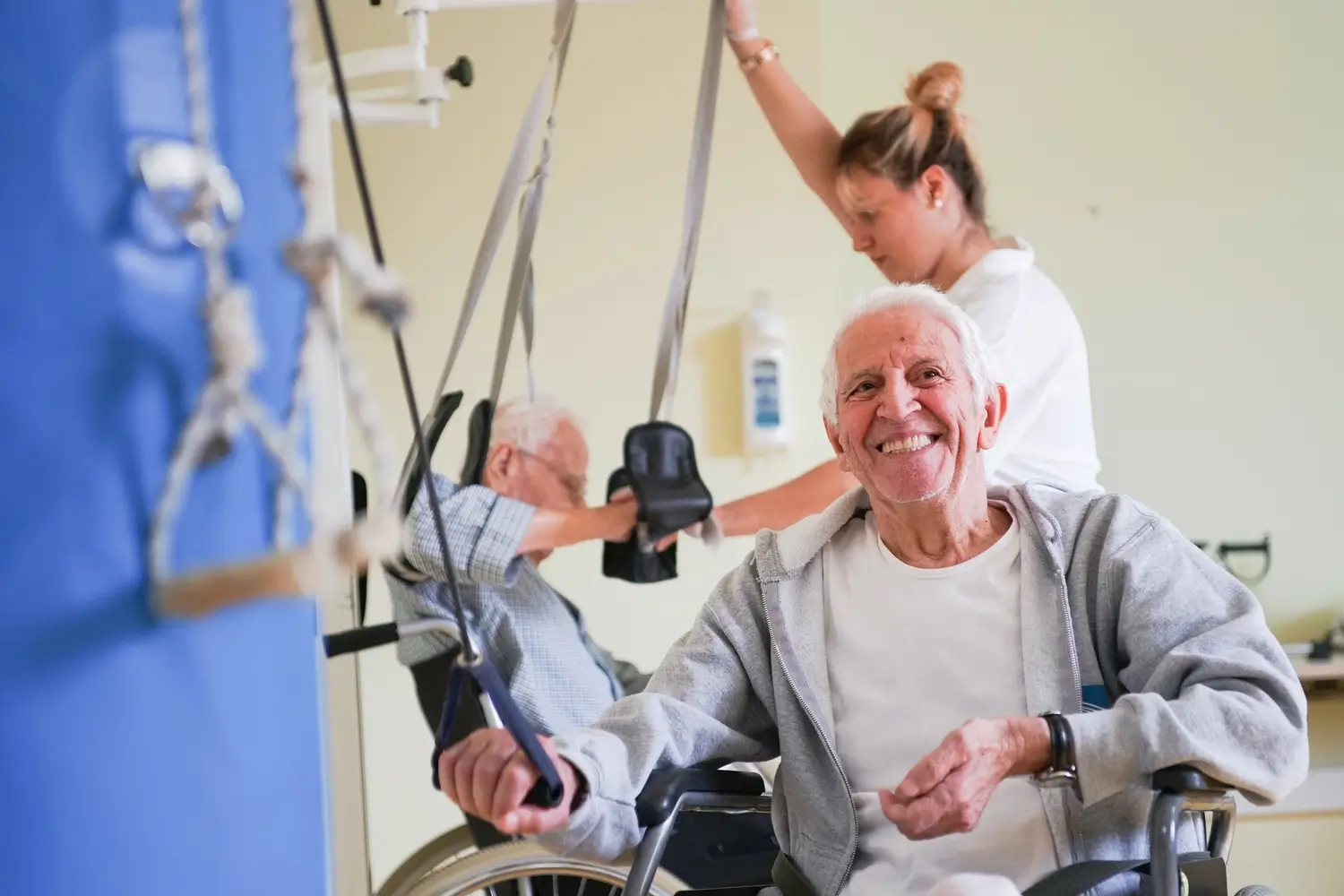
Stroke rehabilitation
Stroke recovery is highly time-sensitive. The first weeks and months are the period of greatest neuroplasticity, when intensive, focused rehabilitation has the largest functional impact. Our stroke programme is built around that window.
Robotic gait training
FES gait training
Hydrotherapy
Speech and language therapy
Specialist rehabilitation after stroke
In plain language
A stroke happens when blood supply to part of the brain is interrupted, either by a clot (ischaemic stroke) or a bleed (haemorrhagic stroke). Cells in the affected area lose oxygen quickly. Depending on which part of the brain is affected, stroke can leave a person with weakness on one side of the body, problems with speech and swallowing, changes in vision, fatigue, mood changes, and difficulties with memory and concentration.
Why specialist rehabilitation matters
After the acute phase, recovery happens in rehabilitation. The brain rewires around the damaged area through a process called neuroplasticity. The earlier and more intensively therapy starts, the more recovery is typically possible. International benchmarks suggest a minimum of three hours of focused therapy per day for stroke patients in the early subacute phase. Many rehabilitation settings cannot deliver that consistently. Ours can.
The Evexia Plus approach
- Daily intensive physiotherapy using Bobath and Padovan methods, with robotic gait training and upper limb robotics for selected patients.
- Speech and language therapy with FEES instrumental swallowing assessment and NMES for dysphagia.
- Occupational therapy targeting activities of daily living, with home-environment planning before discharge.
- Neuromodulation (HD-tDCS, Photobiomodulation) used adjunctively to enhance neuroplasticity.
- Hydrotherapy in our three-pool complex, especially for patients in the early mobility phase.
- Psychology and neuropsychology support for mood, attention, memory and adjustment.
- At least three hours of structured therapy every weekday, more where the consultant judges the patient will benefit.
- Indicative length of stay: four to eight weeks, reviewed weekly with the multidisciplinary team and the patient.
Suitability
We accept patients medically stable enough for active rehabilitation. We do not require patients to be ambulatory on admission. We ask for a recent medical summary, current medications list and (where available) recent imaging, so the multidisciplinary team can plan the programme before you arrive.
Linked services
- Physiotherapy & Robotics
- Speech & Swallowing
- Neuromodulation
- Hydrotherapy
- Psychology & Neuropsychology
- Occupational Therapy
Cost
Cost is discussed individually. See How It Works for the categorical breakdown of what is reimbursable by the HSE under the Cross-Border Directive. Speak with our Irish team for a personalised estimate.
Most families start with one phone call.
Tell us about your family member. Our Irish team explains the EU Cross-Border Directive, confirms whether Evexia fits, and outlines next steps. No referral or paperwork needed for the first call.