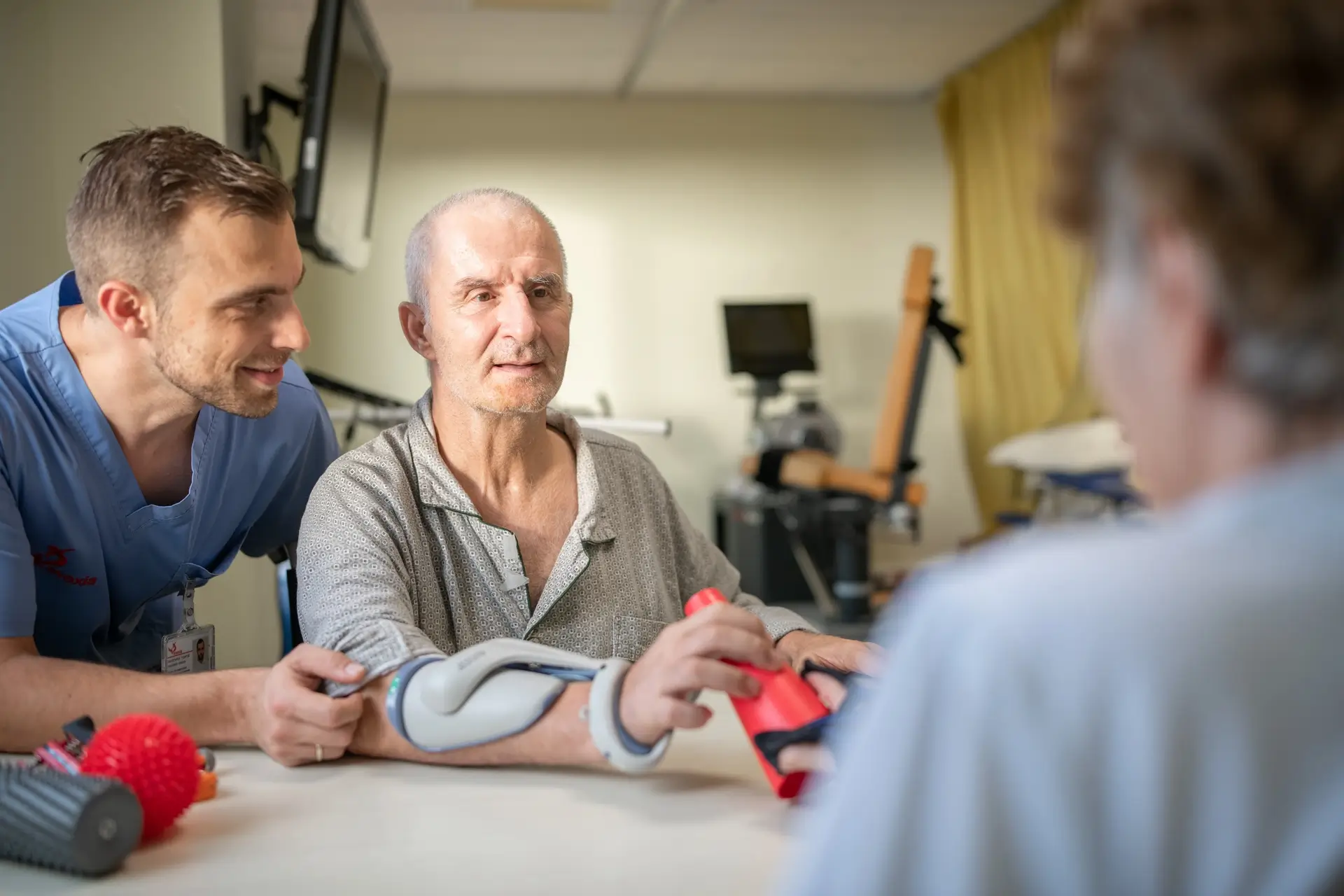
Other neurological conditions we treat
Not every condition needs its own page to get its own programme. Everything here is treated under the same consultant-led model as stroke or brain injury: a Physical Medicine and Rehabilitation Physician designs an individual programme, a multidisciplinary team delivers it daily, and Irish patients access it under the EU Cross-Border Directive.
Speech and language therapy where indicated
Neuromodulation (HD-tDCS, Photobiomodulation)
Hydrotherapy
Psychology support and on-site pain management
Conditions covered on this page
- Guillain-Barré Syndrome
- Motor Neuron Disease
- Peripheral Nerve Injuries
- Neoplasms (nervous system tumours)
- Polyneuropathies
- Myopathy
- Post-neurosurgical rehabilitation
- Vertebral fractures
Guillain-Barré Syndrome
Guillain-Barré Syndrome is an autoimmune condition in which the immune system attacks the peripheral nerves, causing rapid-onset weakness that can progress to temporary paralysis, often following an infection. Recovery is frequently substantial but depends on sustained, intensive physiotherapy to rebuild strength, mobility and stamina. Our programme combines daily physiotherapy and occupational therapy with hydrotherapy and fatigue management, supervised by the medical team throughout.
Motor Neuron Disease
Motor Neuron Disease is a progressive condition affecting the nerves that control voluntary muscle movement, leading to changes in mobility, speech and swallowing. Rehabilitation does not reverse the condition, but a well-designed programme helps maintain function and independence for as long as possible, manage symptoms, and improve day-to-day quality of life. We focus on physiotherapy, occupational therapy, speech and language therapy, and assistive technology, with psychology support for patient and family.
Peripheral Nerve Injuries
Peripheral nerve injuries involve damage to nerves outside the brain and spinal cord, often after trauma or surgery, causing weakness, altered sensation or pain in the affected area. Targeted rehabilitation supports nerve recovery, rebuilds strength, and retrains sensation and function. Our team uses daily physiotherapy and occupational therapy, with Functional Electrical Stimulation and EMG biofeedback where indicated.
Neoplasms (nervous system tumours)
Rehabilitation after a brain or spinal tumour, or after its treatment with surgery or radiotherapy, addresses the functional effects that can follow: weakness, fatigue, cognitive changes, and difficulties with mobility, speech or swallowing. Our multidisciplinary programme brings together physiotherapy, occupational therapy, neuropsychology and speech and language therapy, coordinated by a Physical Medicine and Rehabilitation Physician.
Polyneuropathies
Polyneuropathies are conditions in which multiple peripheral nerves are damaged, from causes including diabetes and inflammatory disease, leading to weakness, numbness, pain and balance difficulties. Rehabilitation targets strength, balance, gait and falls prevention, alongside education on long-term self-management. Hydrotherapy is often particularly effective for balance and mobility work.
Myopathy
Myopathies are diseases of the muscles themselves, causing weakness and reduced endurance. Rehabilitation uses carefully dosed strengthening, energy conservation strategies, and adaptive techniques to protect and maximise function without overloading the muscles. Programmes are individualised and closely supervised by the clinical team.
Post-neurosurgical rehabilitation
Recovery after brain or spinal surgery is shaped by what happens in the weeks that follow. Early, intensive, multidisciplinary rehabilitation addresses the functional effects of surgery, from movement and balance to cognition, speech and daily independence. We coordinate closely with the referring surgical team and design the programme around each patient's specific goals.
Vertebral fractures
Vertebral fractures, whether from trauma or from conditions such as osteoporosis, can affect mobility, cause significant pain, and in some cases involve neurological symptoms. Rehabilitation combines pain management, safe and progressive mobilisation, strengthening and posture work, with education on bone health and falls prevention. The programme is supervised by our medical team with on-site pain management.
The Evexia approach
- A programme designed by a Physical Medicine and Rehabilitation Physician for your specific case.
- Daily physiotherapy, occupational therapy, and (where indicated) speech and language therapy, neuromodulation, and hydrotherapy in our three-pool complex.
- Pain management and acute medical care on-site, including 24-hour medical and nursing cover.
- Bladder and bowel programme where indicated.
- Psychology support for adjustment, mood and sleep.
- Indicative length of stay: three to twelve weeks, depending on condition and goals.
Suitability
We accept patients medically stable enough for active rehabilitation. Send a recent medical summary, current medications list and any imaging to us, and our PRM Physician will assess suitability and propose a programme.
Linked services
- Physiotherapy & Robotics
- Hydrotherapy
- Occupational Therapy
- Speech & Swallowing
- Neuromodulation
- Psychology & Neuropsychology
Cost
Cost is discussed individually. See How It Works for the categorical breakdown of what is reimbursable by the HSE under the Cross-Border Directive. Speak with our Irish team for a personalised estimate.
Common questions
Which neurological conditions does Evexia treat beyond its main condition pages?
This page covers Guillain-Barré Syndrome, Motor Neuron Disease, peripheral nerve injuries, nervous system tumours and post-tumour rehabilitation, polyneuropathies, myopathy, post-neurosurgical rehabilitation, and vertebral fractures. All are treated under the same consultant-led, multidisciplinary model.
Can rehabilitation for these conditions be funded by the HSE?
Yes. Treatment is reimbursable by the HSE under the EU Cross-Border Healthcare Directive, with a public-system referral. No medical card or private insurance is required.
How long is a typical rehabilitation stay?
Most stays run from three to twelve weeks, depending on the condition, its severity, and the patient's goals. The length is reviewed with the multidisciplinary team during the admission.
Is rehabilitation worthwhile for a progressive condition such as motor neuron disease?
Yes. For progressive conditions, rehabilitation focuses on maintaining function and independence, managing symptoms, and improving quality of life, rather than on reversing the condition.
How do I check whether a condition is suitable for admission?
Send a recent medical summary, current medications list and any available imaging to our Irish team. Our PRM Physician will assess suitability and propose a programme. You can call our Irish team on +353 1 263 3051.
If you did not find the diagnosis on our pages, start here.
Name the condition and describe where things stand. Our physician reviews every enquiry individually, and if rehabilitation cannot help, we will say so rather than sell to you.