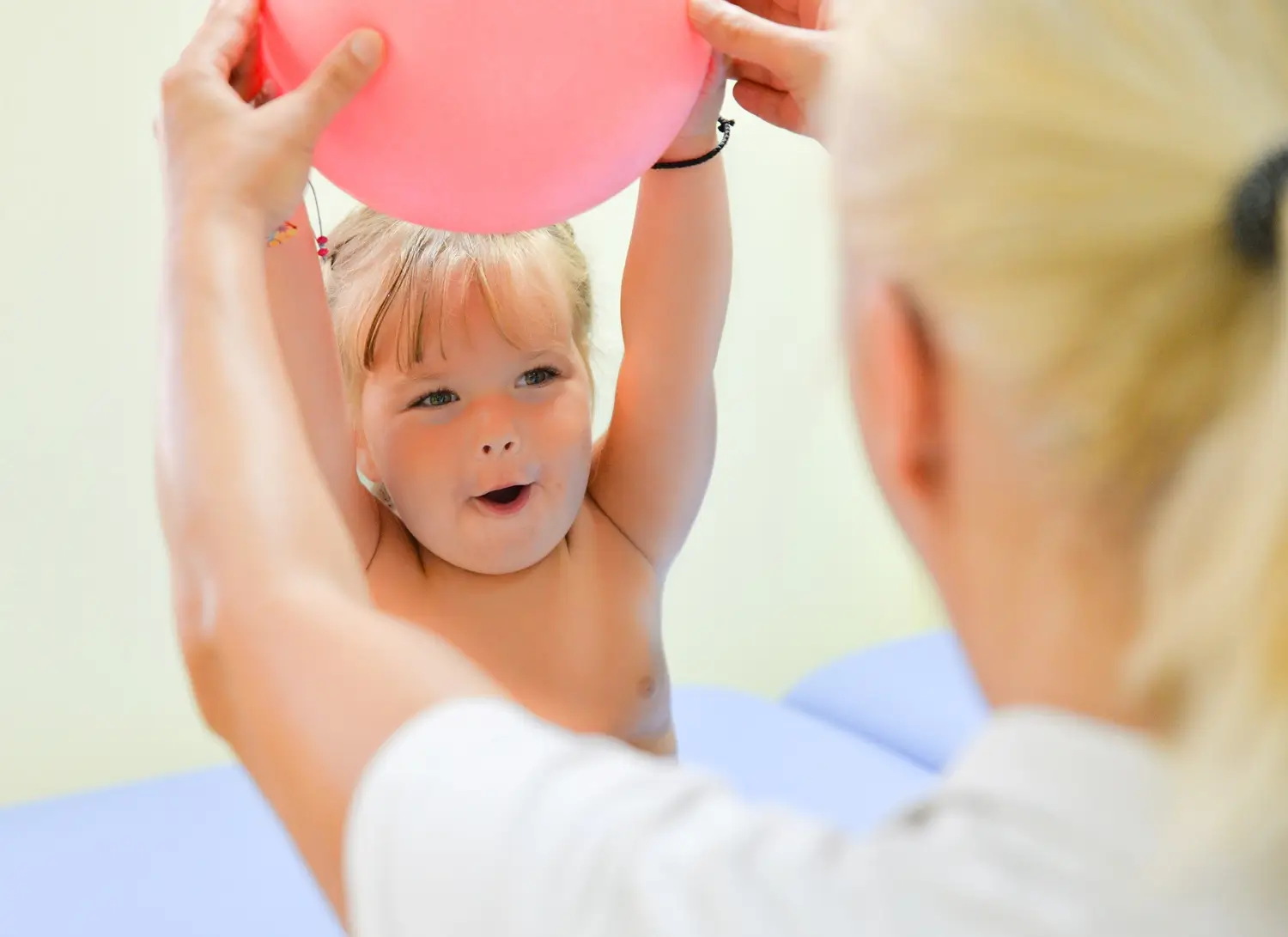
Paediatric rehabilitation
Children do not recover like small adults, and we do not treat them that way. The paediatric programme is built on intensive therapy that feels like play where it can, family-centred care that keeps a parent beside the child throughout, and continuity with school and home life in Ireland. Most admissions are time-limited blocks with specific functional goals, designed to supplement the care your child already receives at home. Every programme is designed by a Physical Medicine and Rehabilitation Physician and coordinated with your child's paediatrician.
Bobath, constraint-induced movement therapy and bimanual training
Speech and language therapy, with AAC where indicated
Hydrotherapy with dedicated paediatric sessions
Family-centred care and psychology support
Conditions covered on this page
- Acquired Brain Injury (including paediatric stroke)
- Cerebral Palsy
- Developmental Delays
- Brain tumours and post-tumour rehabilitation
- Hypoxic-ischaemic injury
- Developmental coordination disorders
- Growth and fine motor skill deficits
Acquired Brain Injury (including paediatric stroke)
Acquired brain injury is damage to the brain that happens after birth, from causes including trauma, stroke, infection or a lack of oxygen. Depending on the area affected, it can change a child's movement, cognition, communication and behaviour. Because a child's developing brain often has considerable plasticity, intensive, age-appropriate rehabilitation at the right stage can deliver functional gains that are hard to achieve through routine community therapy. Our programme combines physiotherapy, occupational therapy, speech and language therapy and neuropsychology, with the family closely involved.
Cerebral Palsy
Cerebral palsy is a group of lifelong conditions affecting movement and posture, caused by injury to the developing brain. Rehabilitation does not cure it, but intensive blocks of therapy can improve mobility, function and independence and support a child's development. We use the Bobath approach, constraint-induced movement therapy, hand-arm bimanual training, and robotic gait training where appropriate, alongside hydrotherapy and family education.
Developmental Delays
Developmental delay is when a child reaches milestones later than expected, across motor, speech, cognitive or social skills. Targeted, intensive therapy supports progress toward age-appropriate skills, with parents involved in goal-setting and a home programme to continue the work after discharge. The programme draws on physiotherapy, occupational therapy and speech and language therapy as each child needs.
Brain tumours and post-tumour rehabilitation
Rehabilitation after a childhood brain tumour, or after its treatment with surgery, chemotherapy or radiotherapy, addresses the effects that can follow: changes in movement, cognition, communication, and energy. Our multidisciplinary team brings together physiotherapy, occupational therapy, speech and language therapy and neuropsychology, coordinated by a Physical Medicine and Rehabilitation Physician and supported by family and psychology input.
Hypoxic-ischaemic injury
Hypoxic-ischaemic injury is brain injury caused by reduced oxygen and blood flow, sometimes occurring around the time of birth, which can affect movement, cognition and development. Early, intensive, age-appropriate rehabilitation supports the developing brain and targets specific functional goals, with the family central to the programme throughout.
Developmental coordination disorders
Developmental coordination disorder is difficulty with coordinated movement and motor skills beyond what is expected for a child's age, affecting daily activities, play and learning. Occupational therapy and physiotherapy target motor planning, coordination and function, building the skills a child needs for independence and participation at home and school.
Growth and fine motor skill deficits
Fine motor skill deficits are difficulties with the small, precise movements of the hands and fingers needed for tasks such as writing, dressing and self-care. Targeted occupational therapy and physiotherapy build strength, dexterity and control, with practical strategies the child and family can carry into everyday life.
The Evexia approach
- Daily physiotherapy and occupational therapy adapted to age and developmental stage. Bobath approach, constraint-induced movement therapy, hand-arm bimanual training, and robotic gait training where appropriate.
- Speech and language therapy targeted to age-appropriate communication and swallowing, with AAC where indicated.
- Hydrotherapy in our three-pool complex, often the most engaging therapy environment for children, with dedicated paediatric session times.
- Family-centred care: parents are involved in goal-setting, daily handover and home-programme design.
- Education-continuity: where stays are longer, we coordinate with the child's school in Ireland to keep learning on track.
- Psychology and family support for the parent and sibling experience.
- Indicative length of stay: two to ten weeks per intensive block.
Suitability
We accept children medically stable enough for active rehabilitation. We work closely with the referring paediatrician in Ireland throughout, including a discharge summary directly to your Irish team.
Linked services
- Physiotherapy & Robotics
- Hydrotherapy
- Speech & Swallowing
- Occupational Therapy
- Psychology & Neuropsychology
Cost
Cost is discussed individually. See How It Works for the categorical breakdown of what is reimbursable by the HSE under the Cross-Border Directive. Speak with our Irish team for a personalised estimate.
Common questions
Which paediatric conditions does Evexia treat?
We treat acquired brain injury (including paediatric stroke), cerebral palsy, developmental delays, brain tumours and post-tumour rehabilitation, hypoxic-ischaemic injury, developmental coordination disorders, and growth and fine motor skill deficits, all under an intensive, family-centred model.
Can children's rehabilitation abroad be funded by the HSE?
Yes. Treatment is reimbursable by the HSE under the EU Cross-Border Healthcare Directive, with a public-system referral. No medical card or private insurance is required.
Can a parent stay with their child?
Yes. We provide free accommodation for one accompanying family member, in the child's room or nearby. Additional family can stay in seaside hotels in Kallikratia, five minutes from the hospital, with a free shuttle bus to Thessaloniki.
Will my child keep up with school during a longer stay?
Where stays are longer, we coordinate with the child's school in Ireland to keep learning on track, as part of our focus on continuity with home and school life.
How long is a typical stay?
Most paediatric admissions are intensive blocks of two to ten weeks, designed to consolidate gains and target specific functional goals, often supplementing the child's regular therapy at home.
How do I check whether my child is suitable for admission?
Speak with your child's paediatrician and send a recent medical summary, current medications list and any imaging to our Irish team. Our PRM Physician will assess suitability and propose a programme. You can call our Irish team on 01 263 3051.
Tell us about your child.
What has happened, what therapy they get now, and what you want the next six months to look like. A parent speaks to our Irish team first, and nothing moves without you.